

How to Share Travel Stories: Retell, the 7th R of Responsible Travel
Travel doesn’t end when you come home or even with your personal reflection of your travel experiences. Rather, it continues through the stories you tell your friends, family, and followers. Considering how to share travel stories responsibly can genuinely transform you from a mere traveler to a changemaker. In this post, we’ll explore strategies for doing just that.
If you’ve missed the previous posts in our series on the 7 Rs of Responsible Travel, be sure to check them out:
The first two Rs of responsible travel happen before the trip begins: Research and Rank.
The next three Rs of responsible travel occur during the trip. They are: Respect, Release, and Relate.
The first five Rs help us prepare for and experience our trips responsibly. The last two Rs of responsible travel come into play after the trip ends. They are: Reflect, and our seventh and final R, the subject of today’s post: Retell.
In the era of social media, stories shape perceptions, influence behavior, and can either reinforce harm or promote understanding of a place and its people. In retelling, you shape how your experiences ripple into the world.
Whether you share stories with your immediate circle of friends and family through conversations and social media posts on a private page, or you’re a travel blogger with a wide public following, responsible retelling can change perspectives, protect vulnerable places, and inspire meaningful action.
Sharing travel stories thoughtfully, with purpose, gives your trip meaning far beyond the memories and souvenirs you’ve collected—even beyond personal growth—to actual positive change in the world.
Retelling With Intention: What Is the Purpose of Your Story?
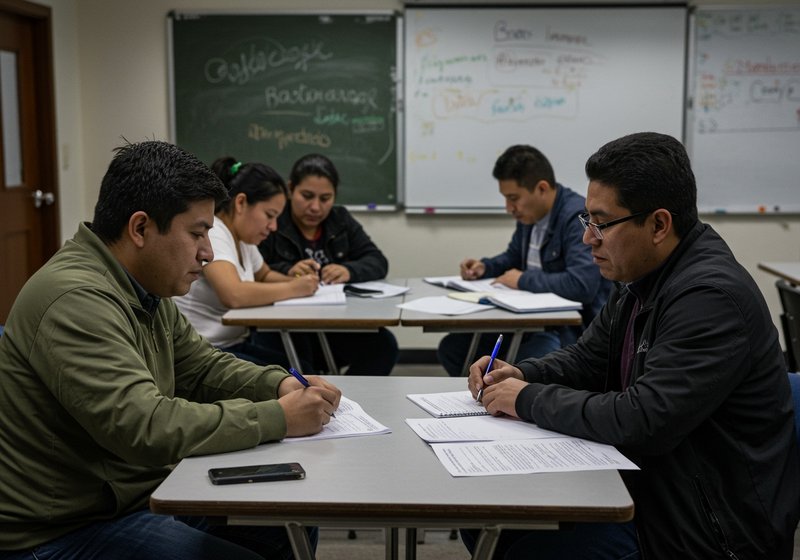
As you return home from your trip and reflect on the cultural experiences you had, consider how to share travel stories in a purpose-driven way. We can each make a conscious choice around what we share with others, and use what we tell to make a difference. Here are some points to consider:
What Can You Change?
What dominant narratives exist about this place? Do people view it overwhelmingly in a certain way? Did you have an intellectual encounter in a place widely viewed as uneducated? Did you encounter wealth in a place widely regarded as poor? Did you observe an act of honesty or kindness in a place widely reputed as dangerous? How can your story gently challenge fear, prejudice, or oversimplification—whether positive or negative?
Everyone carries stereotypes—even well-intentioned travelers including me. If a sentence about a place could start with “Everyone there…” or “They’re all…” (even if what you say next is a “nice” thing), it probably needs more nuance.
What perspective can you offer that people don’t usually hear? Were you the recipient of an act of generosity by someone with far fewer resources than yourself? Did you observe anything that changed your previous perspective on a place, people group, or industry?
Telling your travel tales responsibly isn’t about proving how enlightened you are—it’s about helping someone else take a small step toward seeing the world a little differently.
It’s worth sharing again the excellent TED Talk by Chimamanda Ngozi Adichie: The Danger of a Single Story. Her Guadalajara anecdote and the universality of stereotype blind spots particularly resonated with me. Take a few minutes to watch:
Responsible travel storytelling trades sweeping statements for specific moments—because as Chimamanda says, no place, and no group of people, is a single story. You’re not telling your friends, family, or followers what to think, but you are giving them raw material—in the form of specific stories and examples—to think and draw their own conclusions with.
Retelling With Care: What Should Be Protected?

In addition to considering the impact of your narrative on the people, when you plan how to share travel stories within your circle of influence, think of the potential impact on the places as well.
Retell Without Revealing Everything
Overtourism has negatively impacted many places in the world. Sometimes we find an amazing off-the-beaten-path destination and we’re tempted to share it with the world. However, fragile ecosystems, small communities, and sacred places can be harmed by exposure.
Rarely if ever does the traveler or content creator intend to bring harm or create a negative impact in a place. However, hyper-visibility can generate unintended consequences. “Hidden gems” stop being so hidden when blog posts, videos, and Instagram photos promising “secret beaches,” “underrated towns,” or “places before they’re ruined” go viral with the routes to them available for all to follow.
Ask yourself, “if what I am sharing were to go viral, what impact might that have on this destination?”
Imagine a sudden influx of visitors to places with no infrastructure.
Imagine the additional trash and traffic that might be generated.
Imagine the locals potentially losing access to some of these places, as has happened with many beautiful beaches around the world.
If the place isn’t well-equipped, it might be ruined precisely because it gets promoted. For vulnerable locations, it might be wise to withhold precise locations to preserve what made them special.
Two Important Questions
Travel stories are powerful. They can amplify voices that rarely get heard—or they can unintentionally drown them out. Responsible retelling asks us to pause before hitting “publish” and consider the ripple effects of our words and images.
Before sharing a story, ask yourself two simple questions:
- Who benefits from this story (me, or this place and its people)? And
- Who might be harmed by it (could it expose anything/anyone to unwanted attention, stereotypes, danger, exploitation, or misrepresentation)?
These questions don’t mean you can’t share. They mean you share with intention.
Giving a Voice to Those Who Don’t Have a Platform
Responsible storytelling is less about speaking for others and more about making space for them to be heard. One of the great aspects of relating with the people in the destination is what we learn through our conversations and interactions with them. When you think about how to retell your trip responsibly with the people back home, think back on these moments.
For example, in my travels in Ecuador, Mexico, and other parts of Latin America, the locals often open up and share with me their experiences and impressions of other foreign travelers and immigrants to their country.
This has informed a lot of my thinking about “responsible expatting” and responsible travel, which I have tried to share through my posts and books, quoting them directly in their words (with their permission) and crediting them.
Retell the Whole Story—Beyond Fear and Outrage
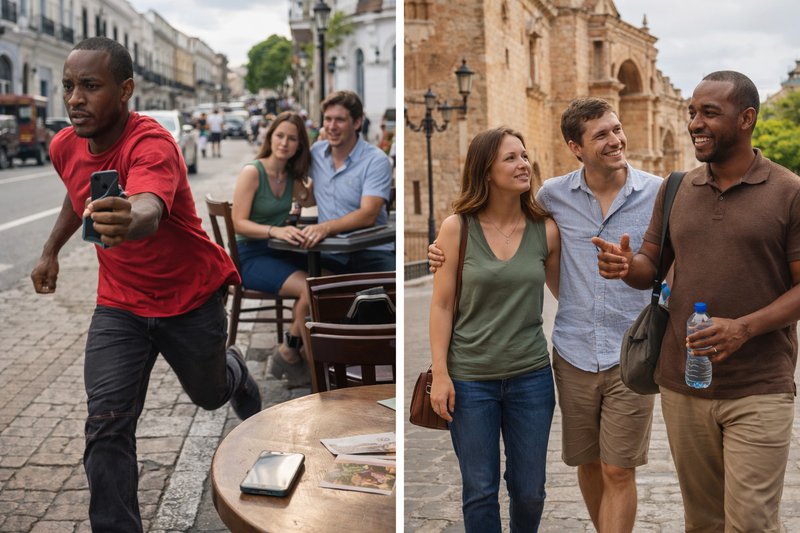
As storytellers, we’re tempted to tell the stories of the awful things that happened and we “lived to tell the tale.” And as consumers of content, these kinds of stories captivate us.
Media and social algorithms capitalize on this. They play on emotions, rewarding fear and outrage, painting whole populations of people in a negative light and creating fear and even hatred of them among other whole populations of people.
However, it’s important, when highlighting a destination and its inhabitants, to avoid distorting the picture of them by providing nuance and honest context.
At its core, responsible retelling isn’t about suppressing difficult truths—it’s about refusing to let them become the only truth.
Scams, poverty, discomfort, and culture shock are real—but incomplete. For every negative experience, there are often dozens of positive ones. In the Dominican Republic, one guy stole our phone, but another guy we randomly met cleared his whole afternoon to show us around Santo Domingo, expecting nothing in return.
Balance is key. I’m not suggesting we paint everything in rosy hues, when obviously the world is imperfect, and good and bad people exist everywhere.
We don’t have to gloss it over. But let’s also highlight kindness, competence, joy, and connection. This is true honest sharing.
Retelling Stories That Surprise People

I feel a particular burden to bring a different perspective when I see that a dominant view about a place or a group of people is heavily skewed. This goes all the way back to my childhood. After having lived for years in Mexico, I had a largely positive experience and many close friends among Mexicans. Yet when we returned to the United States, I heard many negative comments and stereotypes about them. I bristled at the broad, mostly negative strokes with which a whole group of people were being painted.
This feeling has resurfaced in a climate where political rhetoric swirls around dehumanizing entire groups of people. I’ve heard them portrayed as thieves, murderers, rapists, pet-eaters, and the primary cause of problems in the United States and other developed nations. As just one example of thousands, in a 2024 presidential campaign speech, immigrants present in the United States without authorization were described as “animals” and “not human,” language that falls squarely within dehumanizing discourse and moves beyond policy critique to personal denigration. I’m alarmed to see even some friends of mine, whom I know to be kind and generous people, buy into these sensationalized lies.
As such, it’s my mission to tell stories—and help YOU tell stories—that include some nuance and resist caricature of the people and places we encounter in the world. In short, let’s show humanity everywhere by sharing our stories differently.
Why Surprise Is Powerful
Unexpected stories stick.
For example, when I share stories of my childhood, where Mexican people (some of whom did not even know us) helped us out in times of dire need, it flips the standard “white savior” narrative most people carry with them when most of the stories they’ve been exposed to are about rich, white humanitarians coming to the aid of poor people in Mexico. You can watch me tell stories HERE (jump to about 6.5 minutes in for a few stories of people helping us, up to about 10 minutes in).
More Examples of Stereotype-Breakers
My particular area of experience is with Mexico/Mexicans, having traveled and lived in the country for quite a few years now. Most Americans’ exposure to people from Mexico comes from seeing them working in agriculture, hospitality, or construction, or from a trip to a very touristy area of Mexico, such as Cancún, where they are shielded from much real-world contact.
To stir up some ideas for sharing your own travel adventures, here is a quick list of other types of stories I could personally tell from my own experiences:
- Mexicans in science and academia. E.g., the astronomers from the nearby university who present astronomy talks for our community here in Mexico.
- Conversations that reveal depth, humor, and intellectual rigor. E.g., my Mexican lawyer friend who shares perspectives in the fields of history, politics, and philosophy.
- Global citizens encountered far from their home countries. E.g., my Mexican opera singer friend and singing teacher who went to teach music in Bhutan for two years.
This is not how the average American thinks of Mexico or Mexicans. Stories like these can be antidotes to simplistic and stereotypical thinking. Think of how to share travel stories that will shatter stereotypes held by your friends, family, and followers back home.
From Stories to Impact: What Actions Can You Encourage?
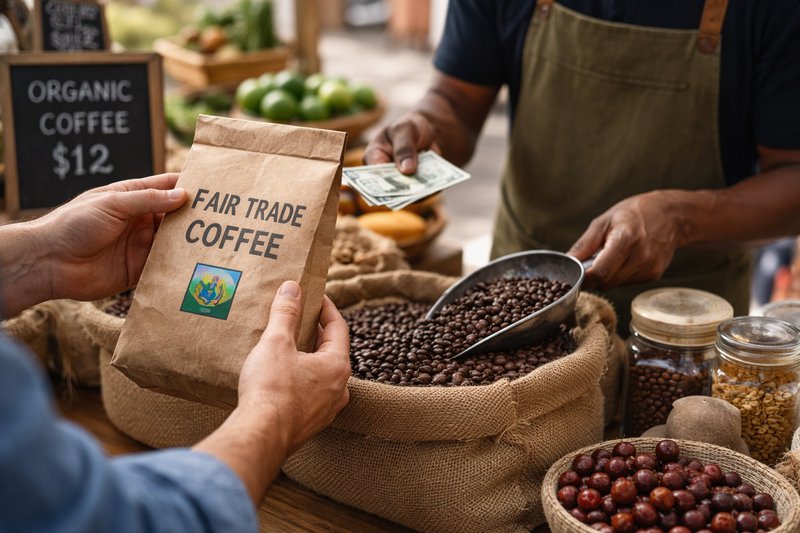
Beyond creating awareness or providing a new perspective, your travel stories can help inspire real action. What can others do after hearing your story?
For example, by sharing my stories of the work that goes into coffee farming and the conversations with farmers who have experienced the difference between conventional and fair-trade practices, I’ve inspired a few people to make the conscious switch to buying fair-trade coffee.
Your stories could inspire others to change the way they travel or even change their buying habits back home. For example, you may inspire others to:
- Support ethical businesses, maybe with some specific recommendations
- Buy fair-trade or locally produced goods
- Donate to or advocate for worthy causes
- Avoid harmful practices
- Boycott unethical businesses
- Pay a fair price for items that took a lot of work to make
Don’t be afraid to add specific calls to action when you share travel stories with others, whether that’s in a conversation or on your personal travel blog. For example, “Next time you buy your coffee, be sure to check that it’s fair-trade.”
Where and How to Share Travel Stories

I used to believe that everyone should travel and be exposed to other ways of life and broader perspectives in order for the world to become a better place. However, that isn’t necessarily the case.
Neither travel nor our travel stories will change everyone. However, it will make a difference with some, and that’s where we need to focus our energy. Here are some places where you can share your stories when you return from a trip:
Private Formats
- Holiday letters
- Conversations
Public Formats
- Blogs & newsletters
- Videos
- Podcasts
- Social media
- Speeches/presentations
- Reviews
Remember, not every story belongs everywhere. Consider how many people your story is likely to reach (reach = responsibility!). Think about how easily this story could resurface later (is it a private conversation or is it a recorded interview that’s likely to be permanently available to the public?). Consider your audience, their interests and their likely attention span, and think of how to retell travel experiences to fit that.
Travel, Global-Mindedness, and the Stories We Carry Home
Over time, I’ve begun to realize that travel alone doesn’t change a person. Some people travel in a way that they remain ideologically insulated either by remaining within their bubbles (resort, expat community, etc.) or by refusing to see or accept anything that doesn’t neatly fit with their pre-existing paradigms.
In contrast, I’ve met “armchair travelers” who have never left their country of origin, and yet they intentionally expose themselves to other cultures, ideas, and perspectives through the programs they watch, the books they read, and the podcasts they listen to.
Even when travel doesn’t transform the traveler, retelling can still transform the listener. Stories can reach people who may never leave their country.
So while we hope our travel stories will help inspire change in the way others travel, we can rest assured that these stories can make a difference even if your listeners never leave town.
Maybe it’s in the way they interact with people in their community who are different from them.
Maybe it’s in what they choose to buy at the grocery store.
Maybe it’s in the habits they change with the environment in mind.
Practical Checklist: Retelling Responsibly
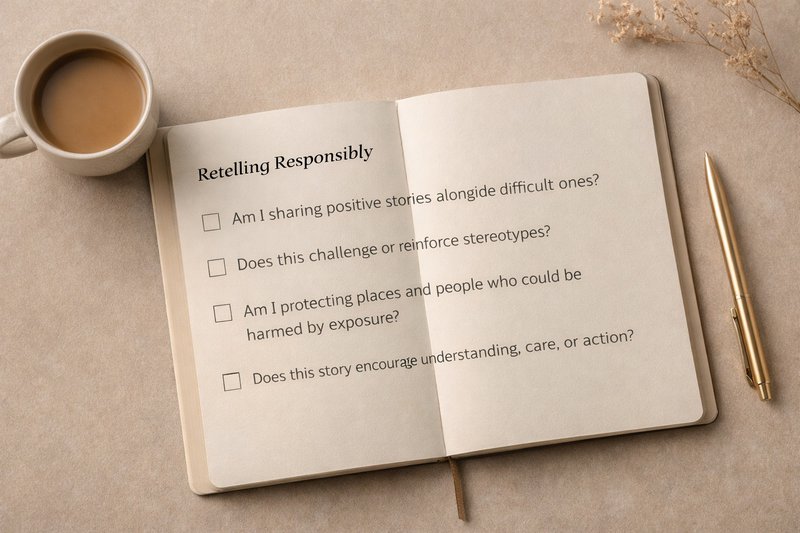
If all of this feels abstract, here’s a simple way to put it into practice. As you plan how to share travel stories with your circle of influence, ask yourself:
- Am I sharing positive stories alongside difficult ones?
- Does this challenge or reinforce stereotypes?
- Am I protecting places and people who could be harmed by exposure?
- Does this story encourage understanding, care, or action?
Conclusion: Your Stories Are Part of the Journey
Responsible travel doesn’t stop when you land back at home. You can keep the trip going with reflection, then retelling of your stories. Retelling is how experiences become influence—how travel can become a force for good.
You’re no longer just a traveler. You are a steward, a translator, and a bridge-builder. When you share what you’ve learned, you help others live, travel, and interact more mindfully.
I hope you’ve found this series on the Seven Rs of Responsible Travel to be useful, thought-provoking, and inspiring. And I hope it’s provided fresh motivation to enjoy your travels and turn them into a force for good for you, for the people and places you encounter, for your friends, family, and followers back home, and ultimately, for the world.
The way we tell our stories shapes the world others learn to see.
Enter your name and email to receive my newsletter and stay up to date!
We hate spam as much as you. Your email is safe with us.